AI Automation · Agent Development
AI Agent Development for Small Businesses
Not a chatbot bolted onto your site. A custom agent that reads what comes in, decides what to do, and acts: qualifying a lead or running an internal step. Built on Flowise, n8n, and Zapier by a senior engineer, and wired into the tools you already run on.
What this is
What "an AI agent" actually means here
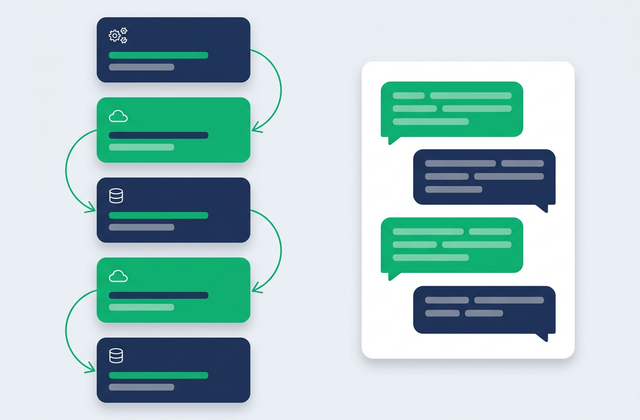
AI agent development means building a system that takes an action instead of only answering a question. iServU designs and builds custom AI agents for small businesses on Flowise and n8n, tools built for multi-step reasoning and tool calling, so an agent can qualify inbound leads or retrieve and summarize information (retrieval, or RAG) before handing off to a person. Where the job is simpler, like connecting two apps on a schedule, Zapier handles it instead. Every agent ships with guardrails, a human-in-the-loop checkpoint on anything consequential, and ongoing evaluation and monitoring so it stays reliable after launch.
What we build
Four agents that earn their keep
-
Lead-qualification agents
Score and route inbound leads automatically so your team only spends time on the ones worth it.
-
Internal ops agents
Handle onboarding steps and approvals end to end, with a human looped in on the calls that matter.
-
Research & summarization agents
Pull from your documents and the web, then return a grounded summary instead of a pile of links.
-
Agent + workflow orchestration
Coordinate multiple agents and automations into one reliable pipeline instead of a stack of disconnected zaps.
Who this is for
Built for operators who already know they want an agent
-
You already run on Zapier, n8n, or spreadsheets
and want the manual step in the middle handled without adding headcount.
-
Leads or requests need to be read and routed before anyone follows up
with automatic routing straight to the right person.
-
You want the person who builds it to also maintain it
and stays hands-on long after launch.
-
You need one agent that does one job reliably
scoped tightly to that one job.
Proof & stack
Where AI agent development pays off
Measured on live client work.
How we build it, and keep it reliable
An agent you can trust is an engineering problem
-
STEP 01
Design
Map the job the agent needs to do and the tools it needs access to. Flag exactly where a human has to stay in the loop.
-
STEP 02
Build
Engineer the agent on Flowise or n8n, wiring in tool calling and retrieval (RAG) against your own data.
-
STEP 03
Guardrails
Set hard limits and approval steps so the agent can't take a consequential action alone.
-
STEP 04
Evaluate
Test against real cases and check accuracy before the agent ever touches production.
-
STEP 05
Maintain
Monitor for drift and keep the agent working as your tools and volume change.
See which repetitive work an agent could absorb
Open the Custom AI Agent Development calculatorKeep exploring
More ways we help
-
AI Automation
The full range of automation and agent-development work we do.
Visit AI Automation -
Consulting Engagements
Retained build and advisory support once the first agent is live.
See consulting options -
Free Assessment
Get a senior engineer's read on what to automate first.
Start a free assessment
FAQ
Agent development, answered
The questions clients ask before scoping their first agent build.
What's the difference between automation and an AI agent?
Process automation follows a fixed set of steps every time, and tools like Zapier or n8n handle that well. An agent makes a decision inside those steps: it reads context, chooses which action fits, and can call different tools depending on what it finds. Most real builds combine both layers.
What can an agent safely do without a human?
Anything reversible and low-risk: sorting, drafting, tagging, routing, or summarizing. Anything that spends money, sends something to a customer, or changes a record of record keeps a human approval step by design.
How do you keep an agent from going wrong?
Guardrails scoped to exactly what the agent is allowed to touch, a human-in-the-loop checkpoint on consequential actions, evaluation against real cases before launch, and monitoring after go-live. An agent that isn't checked after launch is the most common failure mode.
What does an agent build cost to run?
It depends on the workflow's complexity and how much it runs, so there's no flat rate to quote up front. A free assessment scopes the specific job and gives you a concrete number before any work starts.
Start here
Have a job in mind for an agent?
Tell us the task. We'll scope the build, covering design and guardrails, starting with a free assessment.
Scope an agent buildNo obligation. A senior engineer reviews every request personally.